What we do. And how it works.
Most practice websites list six headings with three lines under each. Instead, we write down what happens in a session, how long it takes, how many sessions are usual and what your doctor has to write on the prescription so we’re allowed to treat you.
Our six treatments in detail
All of them can be done on a statutory insurance prescription. Without a prescription we treat you as a self-payer, and you’ll find those prices further down.
Physical therapy
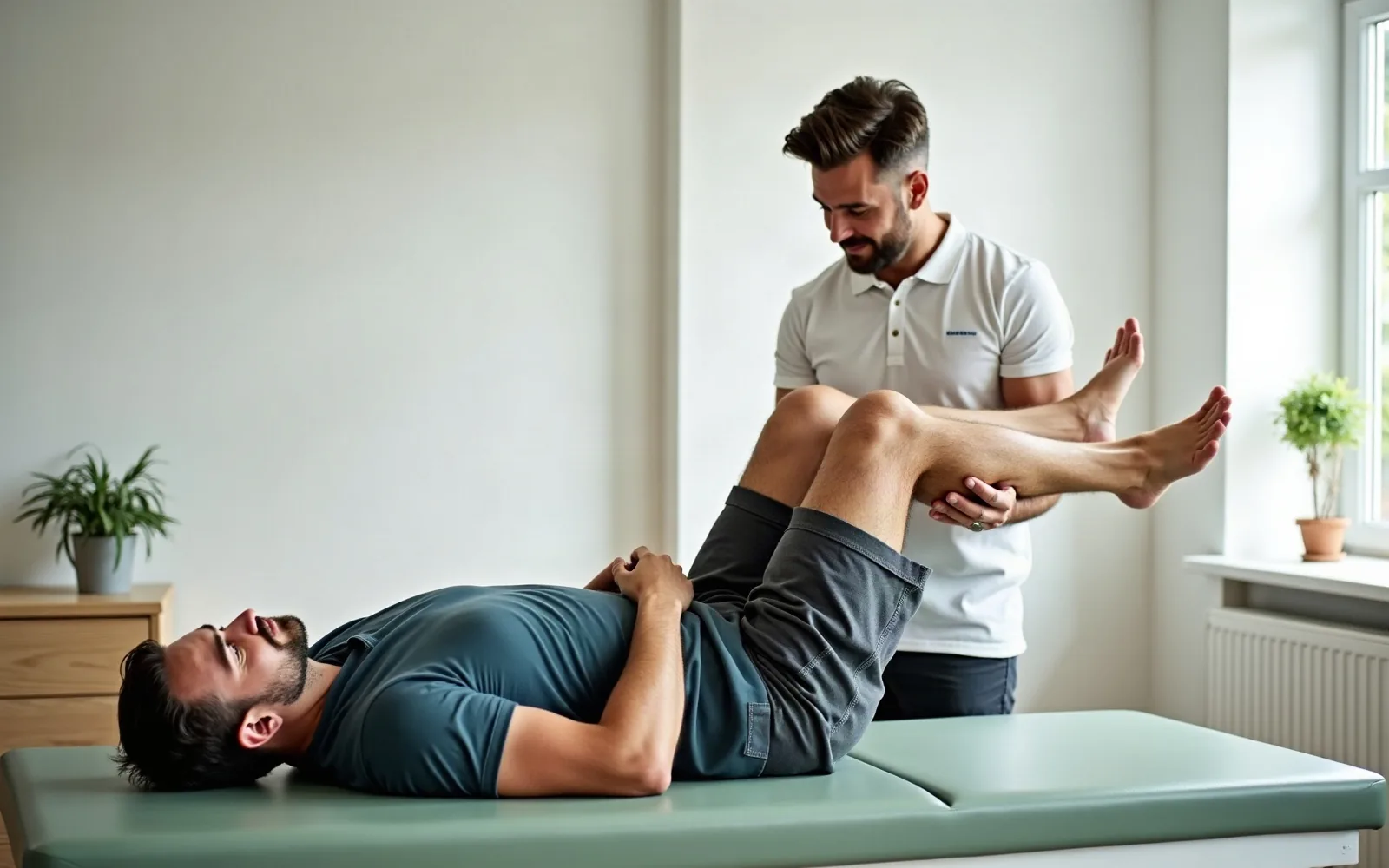
Physical therapy is the most common prescription that comes across our front desk. First we look at which movement is missing, which one hurts and why, and then we work on it with active exercises, guided movements, stretching and strengthening. A session starts with two or three questions about the past week, then comes the active part, and at the end there’s often some hands-on work for muscles that won’t loosen up any other way.
It makes sense after surgery on the knee, hip or shoulder, after broken bones and torn ligaments, for back problems, after a slipped disc and for anything your doctor has checked out beforehand. You leave with two or three exercises for home, not a whole sheet full. What you do between appointments ends up mattering more than what we do here.
- Length of each session30 minutes, first appointment 45
- Usual number6 sessions per prescription
- On the prescriptionTherapy type KG, diagnosis group, number, frequency
- BillingStatutory insurance, private or self-pay
Manual therapy
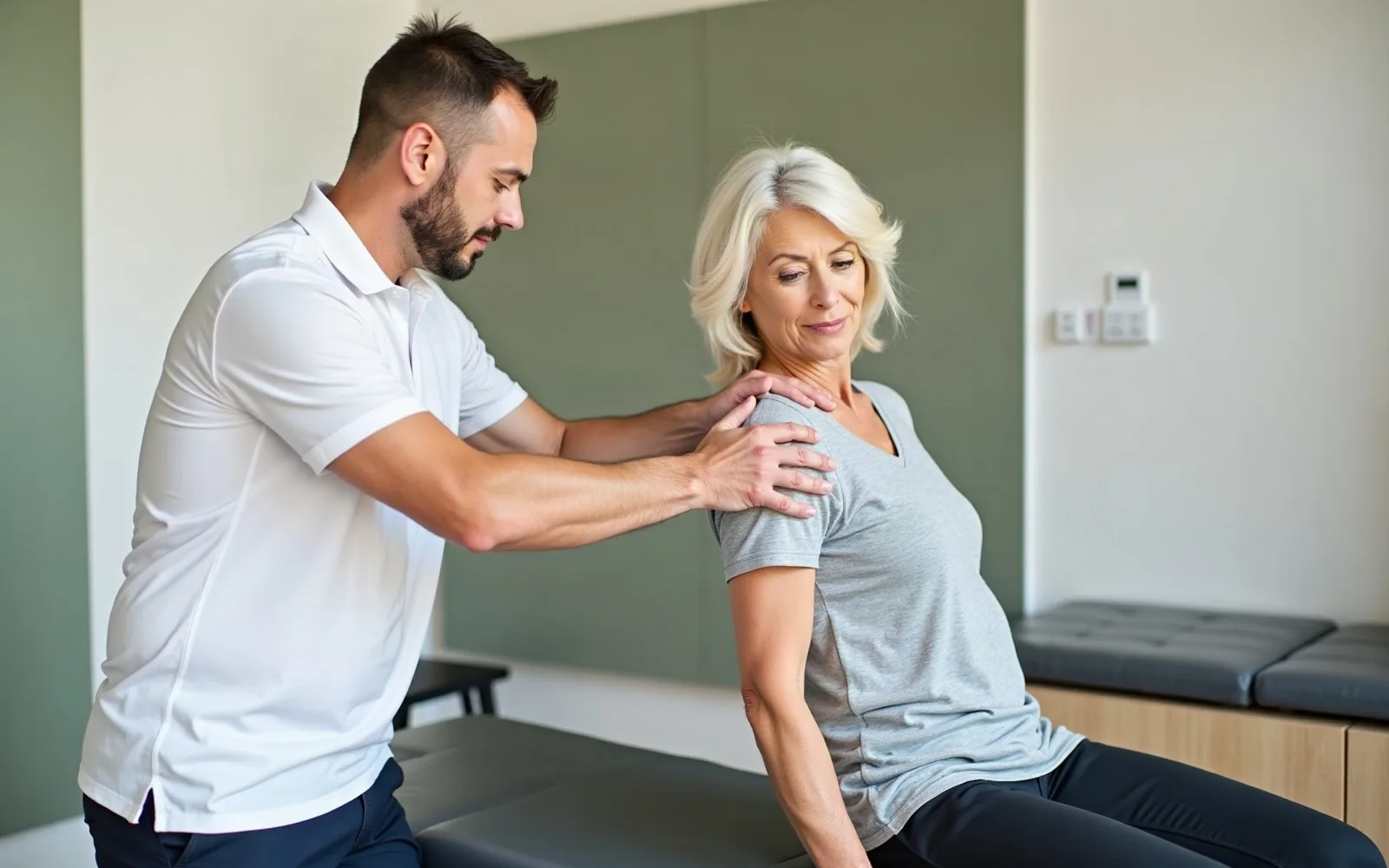
In manual therapy we work with our hands directly on the joint and the muscles that guide it. First we test joint by joint until it’s clear which one is really restricted, and then we free it up with measured techniques, traction and mobilization. This isn’t cracking things back into place at any cost. It’s slow work on mobility, and it’s almost always followed by exercises so the result lasts.
Typical reasons are a stiff shoulder, a neck that won’t turn anymore, problems with the sacroiliac joint, restricted movement after a cast or splint, and jaw or head pain that comes from the neck. Only therapists with the extra qualification are allowed to bill for manual therapy. On our team, that’s Katharina, Stefan and Anna. So we may give you a specific therapist for MT and not the one you last trained with.
- Length of each session30 minutes
- Usual number6 sessions per prescription
- On the prescriptionTherapy type MT, diagnosis group, number, frequency
- RequirementTherapist with the extra MT qualification
Manual lymphatic drainage
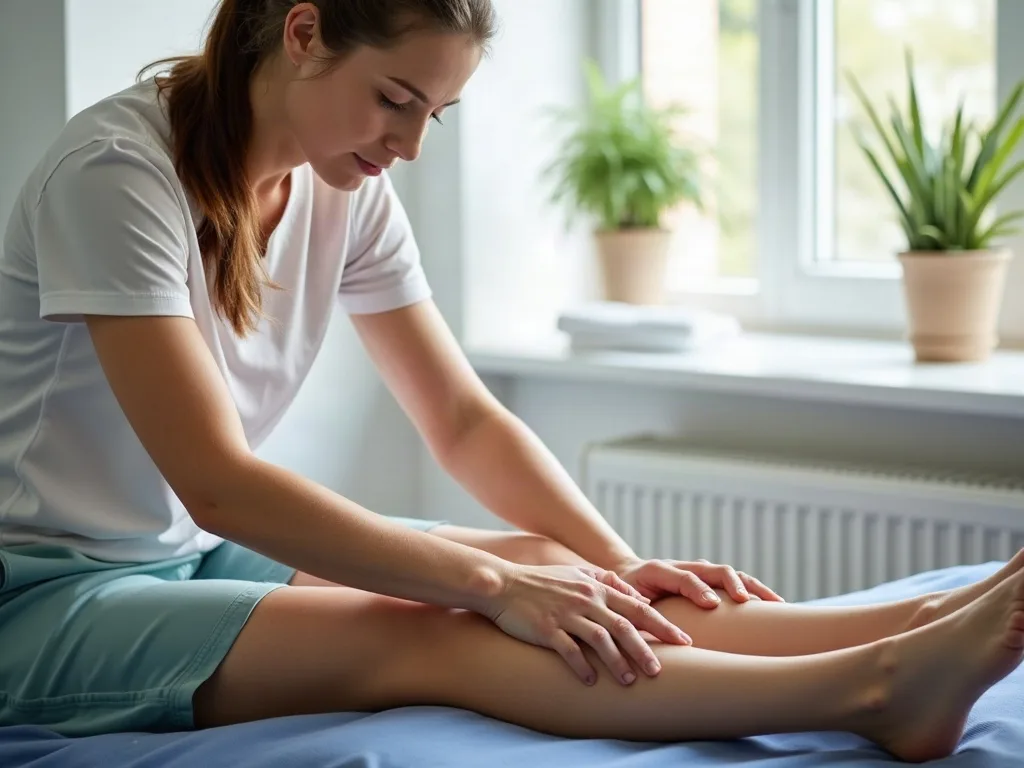
Lymphatic drainage is the gentlest treatment we offer and the one with the least pressure. With very light, circular movements we move fluid out of the swollen tissue back toward the lymph nodes. We don’t start at the swelling itself but at the neck and trunk, so the drainage path is open in the first place. Many patients get sleepy during it, and that’s normal.
It’s prescribed after surgery where lymph nodes were removed, for lymphedema and lipedema, for heavy swelling after knee and hip replacements and after injuries. The time matters. Your doctor states on the prescription whether we treat for 30, 45 or 60 minutes, depending on how many areas of the body are affected. If bandaging or fitting compression garments is also needed, that has to be on the prescription too.
- Length of each session30, 45 or 60 minutes as prescribed
- Usual number6 to 10 sessions, often as a series
- On the prescriptionMLD with time, diagnosis group, compression if needed
- BillingStatutory insurance and private
Classic massage
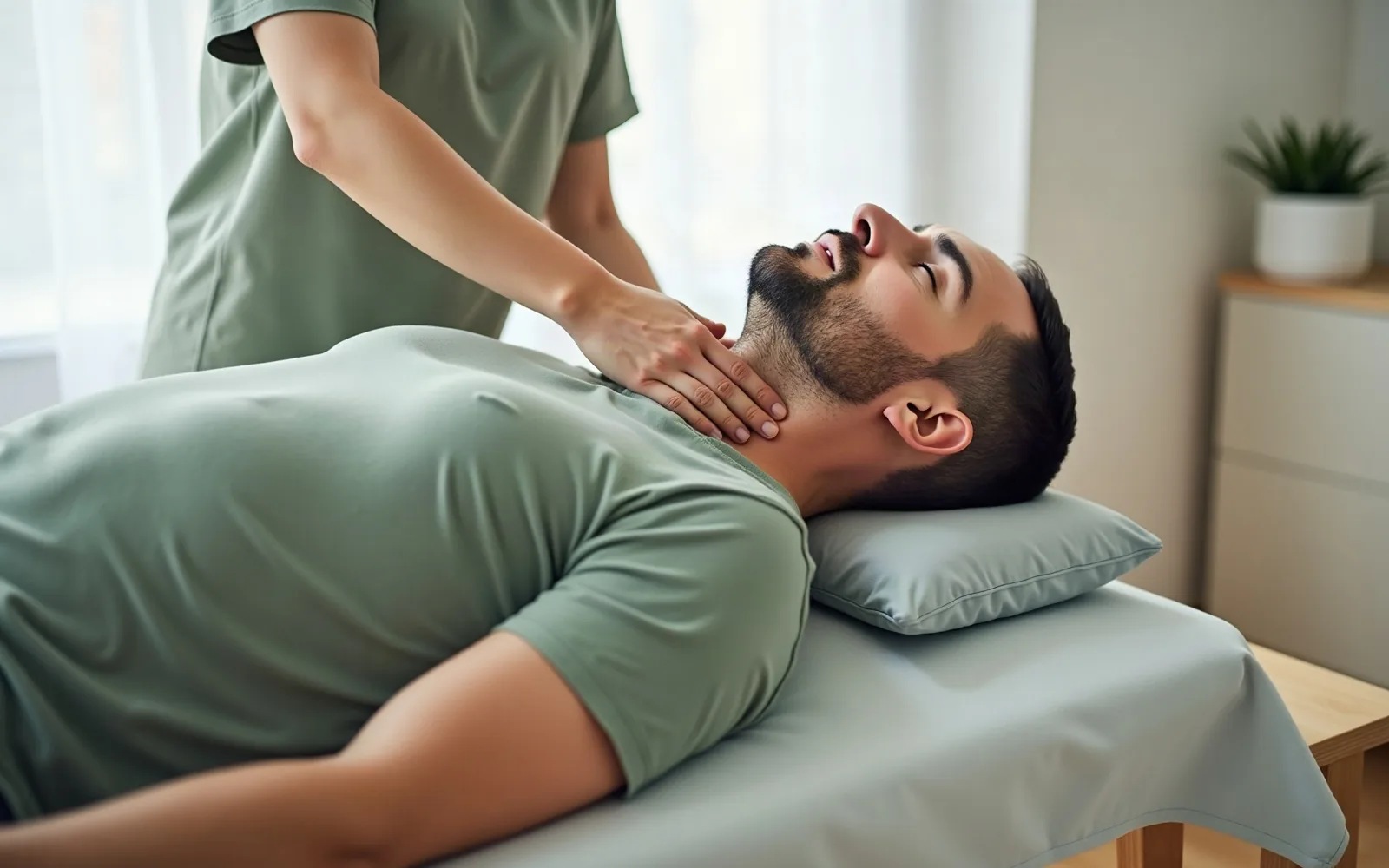
Classic massage therapy works on tense muscles with stroking, kneading and friction. You lie warm and covered while we treat the prescribed area, usually the neck, the shoulders or the lower back. If needed, we apply heat first so the tissue gives a little more.
To be honest, a massage rarely fixes the cause. It takes the pressure off, loosens you up and feels good, and it’s a good warm-up for the active work afterward. If your tension comes back every four weeks, it’s usually down to posture, strain or a lack of strength, and then physical therapy is the more sensible prescription. We’ll tell you that, even if your prescription says something else.
- Length of each session20 to 30 minutes, depending on the area
- Usual number6 sessions per prescription
- On the prescriptionTherapy type KMT with the body area
- Without a prescriptionalways possible as a self-payer
Physio on equipment
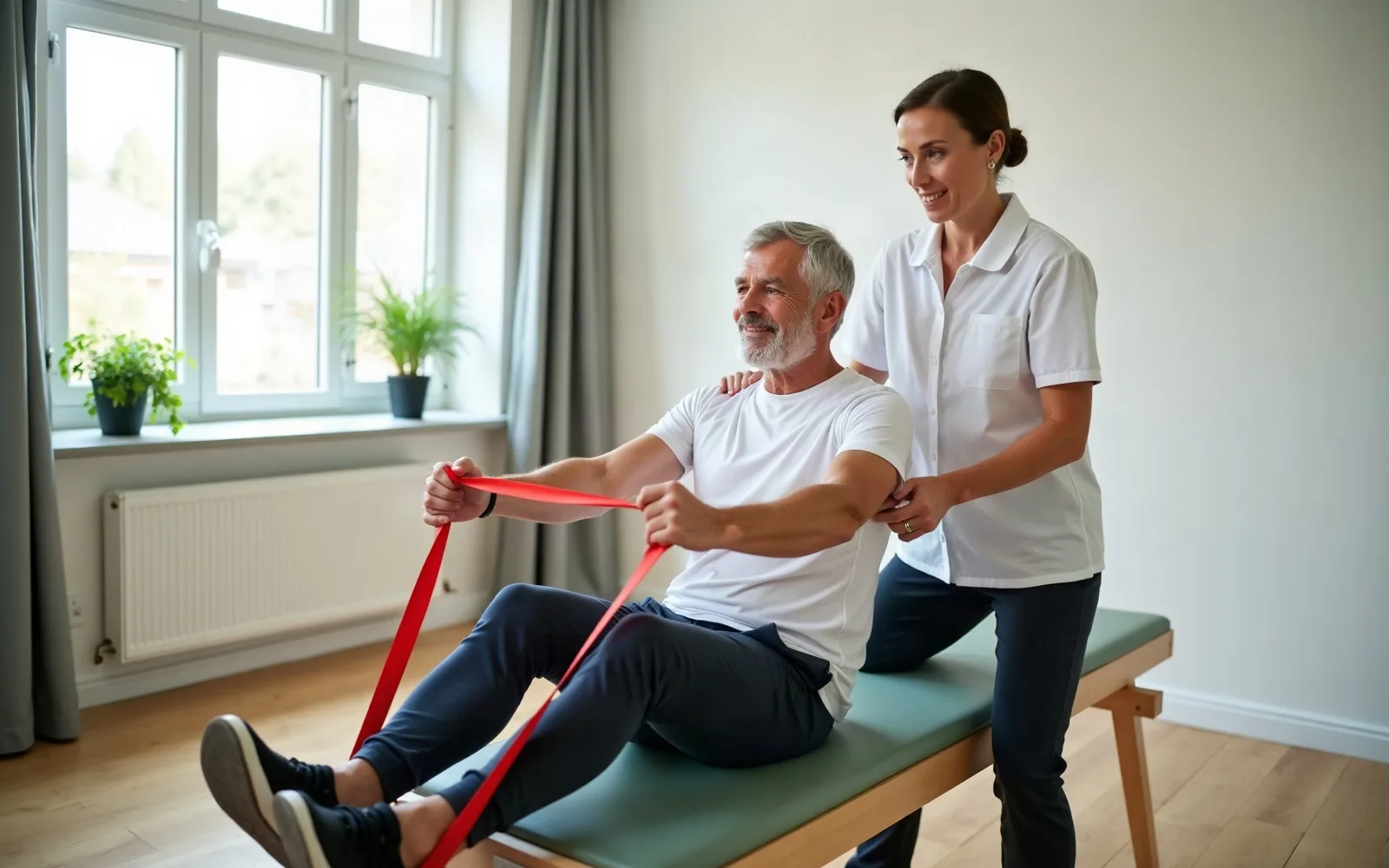
Physio on equipment is medical training on the cable machine, leg press and ergometer, planned and supervised by a therapist. A session lasts 60 minutes and consists of a warm-up, your training plan with usually six to eight exercises and a short cool-down. We write down the weights and increase them week by week, so you can see that something is changing.
It makes sense after spinal disc and joint surgery, after a long period of rest, for recurring back pain and whenever strength is missing, not just mobility. The practice needs its own approval from the health insurers for this, including inspected equipment, and we’ve had it since 2014. In equipment therapy one therapist looks after up to three patients at once, as the approval requires. Please bring clean indoor shoes and a towel.
- Length of each session60 minutes
- Usual number6 sessions, usually several prescriptions
- On the prescriptionTherapy type KG equipment, diagnosis group, number
- Without a prescriptionas a training session for self-payers

Home visits
If you can’t make it to the practice, we come to you. We treat what’s on the prescription, so physical therapy, manual therapy or lymphatic drainage, just at your bedside, in the living room or in the hallway where there’s room to walk. We work with what’s there and bring small equipment along. We don’t bring a treatment table.
For us to come, your doctor has to tick the home visit box on the prescription. If the box isn’t ticked, we’re not allowed to drive out to you, even if it’s obviously needed. We bill the travel allowance to the insurer, it counts as part of the costs and so goes into the ten percent co-payment. We do home visits within about 15 kilometers, usually in the morning or late afternoon within a one-hour window. Slots are limited, so ask early.
- Length of each sessionsame as at the practice, plus travel
- Time windowmornings or from 16:00, 60-minute window
- On the prescriptionTherapy type plus the home visit box ticked
- AreaMusterdorf and neighboring villages, about 15 km
Prices for self-payers, no prescription needed
You don’t need a prescription to come to us. Without one, we treat you as a self-payer and bill you directly.
Sample prices for this sample practice
- Classic massage, 30 minutes€39
- Classic massage, 45 minutes€55
- Physical therapy, 30 minutes€45
- Manual therapy, 30 minutes€52
- Lymphatic drainage, 45 minutes€58
- Equipment training session, 60 minutes€45
- 10-session training card€400
Sample figures for this sample site. A real practice puts its own price list here and keeps it up to date. What we tell you on the phone or at the front desk is always what counts.
What self-payers should know. You pay for the treatment in full yourself. In return there’s no co-payment, no 28-day deadline and no limit on how many sessions are allowed. You decide how often you come.
We give you an invoice with all the details. Whether your supplementary insurance or your employer will reimburse any of it, please check with them beforehand. It varies from plan to plan and we can’t promise you anything.
You pay at the front desk after the treatment, cash or card. You get the receipt right away.
If during the examination we get the impression that something behind your symptoms needs a doctor’s attention, we’ll say so and send you to a doctor. Even if you’ve just paid. Everything else about prescriptions and co-payments is on the page Prescription and co-payment.
What we don’t offer
So you don’t make the trip for nothing. Four things you won’t get here, and where you can go instead.
Not offered here
- No osteopathy. Nobody on our team has the years of training it takes. If you’re looking for osteopathy, get it from someone who has really learned it.
- No acupuncture, no cupping, no homeopathy. We stick to what belongs to physiotherapy.
- No open gym. Our training area isn’t a gym you stroll into with a monthly pass. On the equipment, everyone works with guidance and a plan.
- No podiatry and no occupational therapy. Both are separate professions with their own licensing. We’re happy to give you addresses nearby.
Why we spell this out so openly. It probably costs us a few calls. But it saves people the drive to Musterdorf for something they won’t get here.
When it comes to treatment, too, we’d rather say no than yes. If a prescription doesn’t match what we find during the examination, we talk to you and, if you agree, to your doctor. We won’t treat something six times when we don’t think it will help.
If you have acute symptoms with warning signs, such as numbness, paralysis, severe pain at night or fever, see a doctor first, not our treatment table. In that case call the doctor’s office, not us.
Who works here and what each of us specializes in is on the Team page.
The practice and its equipment
Ground floor, step-free entrance, a good 220 square meters in total. Here’s what you’ll find.
Four treatment rooms
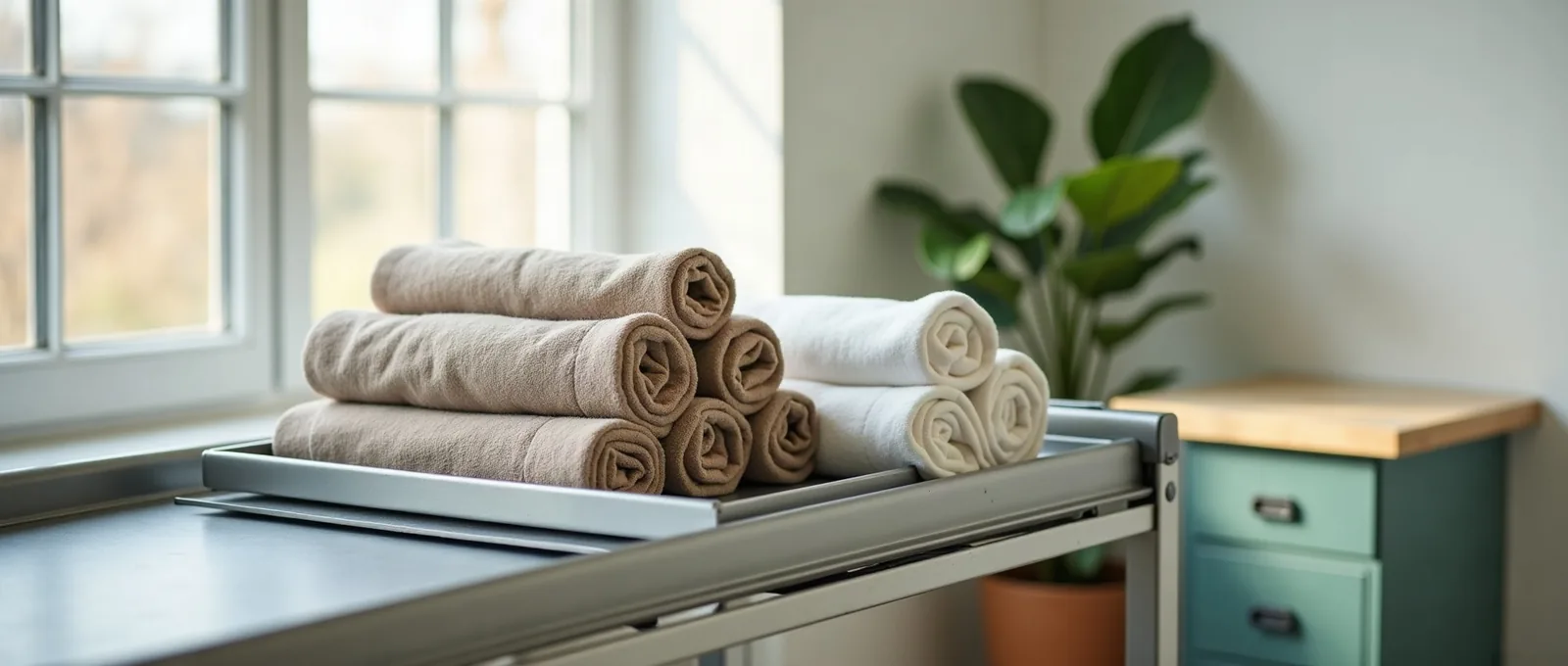
Proper single rooms with a door, not curtained cubicles. Height-adjustable tables, a sink in every room, windows you can open.
Every room has space for a chair in case someone comes along with you.
Quiet and private90 m² training area
A separate room for equipment-based physio (KG am Gerät), apart from the treatment rooms. Cable pulley, leg press, exercise bike, plus dumbbells, bands and mats.
The equipment is inspected for health insurance approval and serviced regularly.
Only with supervisionHeat and cold
Fango, hot roll, cold and warm packs. We use them as preparation when they’re on your prescription or when they make sense therapeutically.
Alongside your treatmentChanging room and restrooms
A changing room with hooks and a bench, lockers for your valuables, and a shower for patients after training.
Please bring a towelAccessible entrance
Step-free entrance, wide doors, room to turn in the hallway, accessible restroom. Wheelchairs and walkers can get everywhere.
No stepsWaiting and parking
A small waiting area with water, six parking spaces of our own in front of the building. Directions and the bus stop are on the Contact and directions page.
Free of chargeQuestions about our services
What people ask most often at the front desk.
Can I choose which treatment I get?
Not on a prescription. The doctor decides what gets treated by writing the treatment on the prescription, and we’re bound by that. If our assessment suggests something else would make more sense, we’ll talk to you and, if needed, to the practice that wrote the prescription.
If you’re paying yourself, you’re free to book whatever you like.
How many sessions am I entitled to?
That depends on the diagnosis group the doctor enters. Six sessions per prescription is usual. If that’s not enough, the doctor can prescribe more, and for some diagnoses over longer periods too. We’ll let you know in good time before your last session so you can sort out a follow-up prescription.
Twice a week, or is once enough?
Your prescription includes a recommended frequency, usually one to three times a week. In the acute phase and after surgery two sessions a week make sense. Later on one is often enough if you practice at home. We go by the prescription and by what you can realistically fit in.
Can I combine manual therapy and massage?
On a health insurance prescription, only if both are prescribed. Massage often counts as a supplementary treatment and has to be written on the prescription explicitly. You can also do the prescribed treatment and add a massage that you pay for privately. Just ask us and we’ll bill the two separately and properly.
Is equipment-based physio the same as rehab sport?
No. Equipment-based physio is a treatment prescribed by a doctor, planned individually and supervised by a therapist. Rehab sport runs in fixed groups through sports clubs and has different requirements. We don’t offer rehab sport.
Do I get a regular appointment, or do I have to call every week?
You get the appointments for the whole prescription as a series, usually at your first visit. For equipment-based physio we schedule fixed training times, because space is limited.
Do you treat children too?
Yes, from school age, for the usual orthopedic issues like posture, misalignments or after injuries. We don’t offer special methods for babies and toddlers. For that we refer you to colleagues with the right additional training. Under 18 there’s no co-payment.
Does one of these treatments sound right for you?
Then get in touch. We’re currently taking new patients, with or without a prescription. It takes one to two weeks until your first appointment.